Hot Hands in the NBA: Is the Streak Real?
Hot Hands in the NBA: Is the Streak Real?
Have you ever watched an NBA game and felt certain a player was “on fire”. When curry drains shot after shot, seemingly unable to miss? This is the classic “hot-hand” phenomenon: the belief that making a few shots in a row makes the next one more likely to go in. But is it real, or just a trick of the mind?
I’ve always loved the drama of a player heating up, but I wondered: does the data back up the hype? Or are our brains just looking patterns in the randomness of basketball? To find out, I dove into NBA shot-by-shot data from the 2024 season.
Exploration
The hot-hand idea is everywhere in sports. Fans and even players swear by it. But back in 1985, Gilovich, Vallone, and Tversky published a famous study suggesting the hot-hand is mostly an illusion and that people tend to see streaks in random sequences, reading too much into them.
To test the hot-hand, I looked at every shot taken in the NBA 2024 season. For each player, I tracked whether they made or missed a shot, then checked what happened on their next attempt. The key question: Is the probability of making a shot higher after a make than after a miss?
This is a classic conditional probability problem. If the hot-hand is real, we’d expect to see a noticeable bump in shooting percentage after a make compared to after a miss.
Drum Rollll…
I calculated the conditional probabilities for makes after makes, and makes after misses, for a huge sample of shots. To make things clearer, here’s a chart from my analysis:
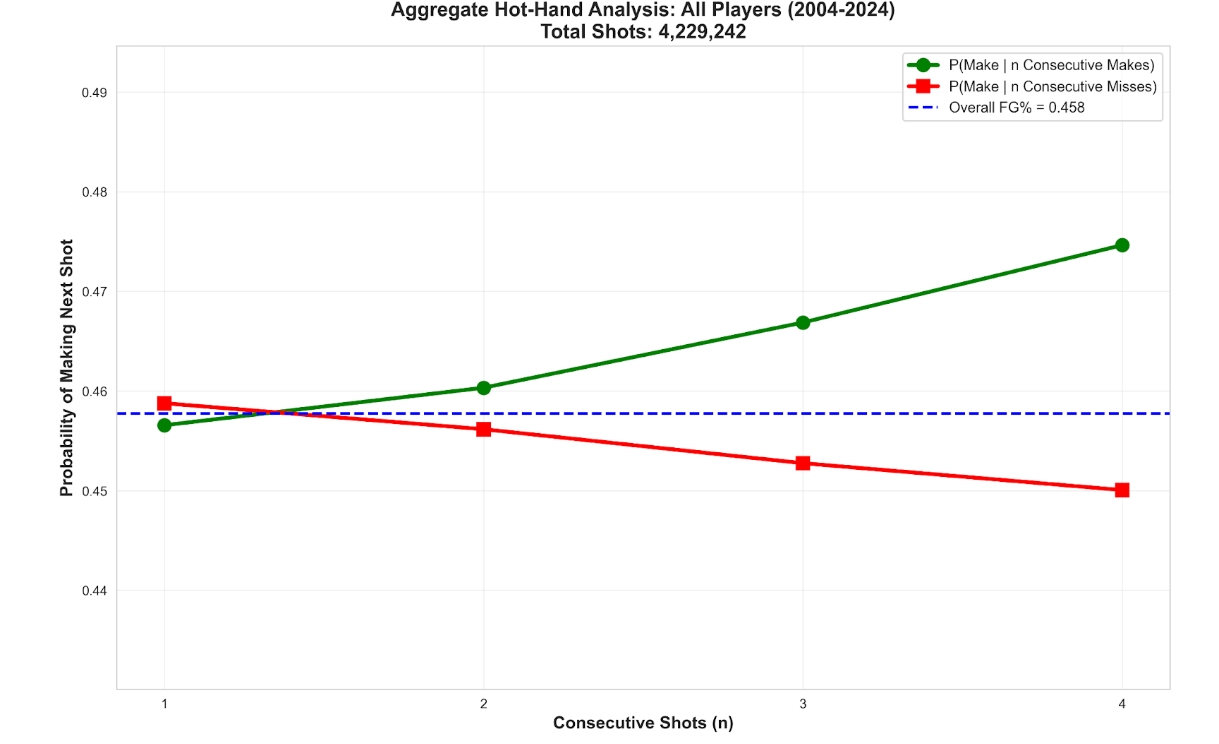
This graph shows the difference in shooting percentage after a make versus after a miss for NBA players in 2024. As you can see, the difference is surprisingly small for most players, suggesting the “hot hand” is more myth than reality.
The Takeaway
So, does the hot-hand exist? The answer is surprisingly subtle. While some players show small streaks, for most, the difference is tiny and often within the margin of randomness. The “hot hand” might be more about our brains loving a good story than about real changes in probability.
FYI: the original study:
Gilovich, T., Vallone, R. and Tversky, A., 1985. The hot hand in basketball: On the misperception of random sequences. Cognitive Psychology, 17(3), pp.295–314.
And if you want to play with the data yourself: NBA Shot Data on Kaggle